
An art review of four resident artists at Baranow Art Gallery
A good collection is not a set of beautiful things. It is a conversation in which each voice sounds distinct, yet together they create a three-dimensional picture. That is exactly how the artist selection at Baranow Art Gallery works: four authors, four completely different ways of looking at reality—and at the same time a surprising sense of inner kinship.
Nikolay Pak seeks the human being within a parable. Igor Nelyubovich turns St. Petersburg into a sign. Evgeny Alekseenko elevates aviation to the level of serious painting. Sergei Nikitin looks at the city as a living organism. Let us examine what makes each of them unique—and why their works should be considered not separately, but as a single curatorial statement.
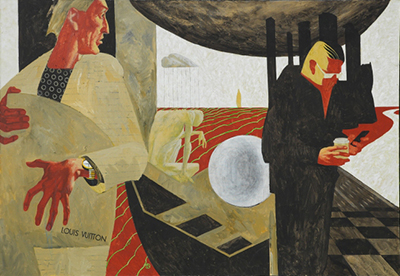
Nikolay Pak was born in 1983 in Bukhara but has lived and worked in Rostov Veliky since 1995—and this shift in cultural context is felt in his work. He has a serious academic background: the Surikov Moscow State Academic Art Institute with a diploma with honors, the Yaroslavl Art School, and the monumental painting department of St. Tikhon's Orthodox University. He is a member of the Union of Artists of Russia and the Moscow Union of Artists, and his works have been exhibited at the Yaroslavl Art Museum and at the Art Russia fair.
But biography is only the foundation. The main thing about Pak is his method. He calls his style symbolic realism and speaks in the language of parable. Portrait likeness is not important to him; what matters is the image of a personality—whether it is a person, a city, a house, grass, or an apple. "My theme is the human being as the main creation of God, his life path, life and death," the artist says.
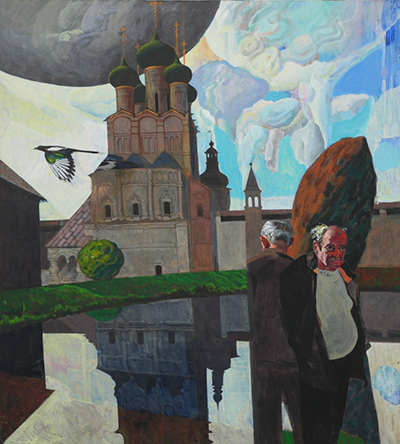
What does this mean for a collector? Pak's works require slow looking. They are not "read" in a second. Behind the simplicity of form lie a second, third, and fourth layer—and that is precisely what makes them interesting for a collection built over the long term. Pak works with eternal questions, but does so without pathos or didacticism. His symbolic realism is not an illustration of ideas but an invitation to co-reflection.
Igor Nelyubovich is an artist with an international reputation. He was born in 1948 in Gorky (now Nizhny Novgorod), but since the early 1990s the term "Nelyubovich's Petersburg" has taken root in cultural usage—so recognizable and personal is his vision of the northern capital.
His method is generalization taken to its limit. "Not an image but a sign. Not a subject but a symbol. Not a moment but eternity," is how the artist himself formulates his creative task. His paintings are graphic, decorative, and possess a special inner construction: the lightness of line is firmly set on the armature of composition. He is best known for the "Red Chair" cycle, as well as abstractions that live outside time and trends.
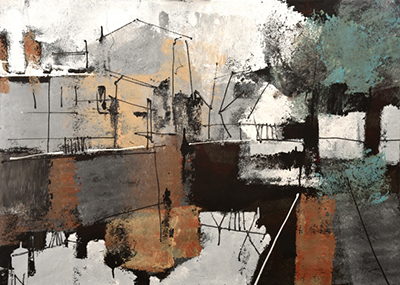
Nelyubovich's track record is impressive: more than 150 international exhibitions, and he is a regular participant in exhibitions at galleries in New York and London. For two years in a row—2021 and 2022—he was the only artist from Russia to enter the top 10 of well-known contemporary artists according to the respected publication Issue of World of Art Contemporary Art Magazine. Most of his sold paintings are in private collections in Europe, the USA, the UAE, and Scandinavia.
For an art advisor and collector, Nelyubovich's works offer a combination of museum-level quality and market stability. He does not follow fashion; his language was formed decades ago and remains recognizable.
This is a case where the artist's name has already become a brand, but behind the brand stands genuine plastic discipline.
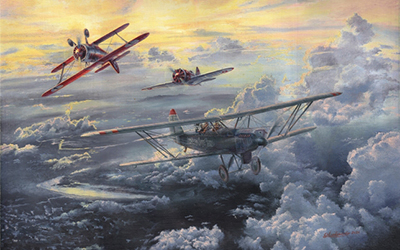
Evgeny Alekseenko was born in 1961. He is a member of the Professional Union of Artists of Russia and the Union of Russian Artists, but his main identity is as the leader of Russian Aviation Art, a genre that in recent decades has become popular among collectors in all developed countries.
Aviation in art is a genre that easily slides into illustration or technical poster. Alekseenko has achieved something else: he has raised Russian Aviation Art from an illustrative and applied role to a full-fledged direction of painting. His works are not simply images of airplanes. They are celestial landscapes in sunlight or moonlight, where machines become part of a larger drama of light and space.
For a collector, this is an interesting segment: a genre with a clear international audience, understandable iconography, and at the same time a strong painterly foundation. Alekseenko's works are held in factory museums and private collections, published in magazines and art albums, and issued as collectible reproductions. This makes his name recognizable not only among aviation enthusiasts but also in the broader field of collectible art.
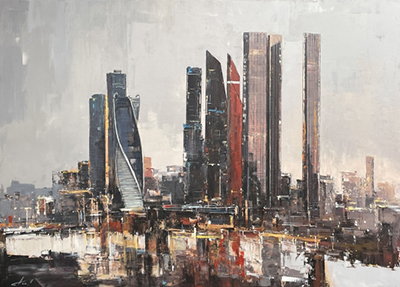
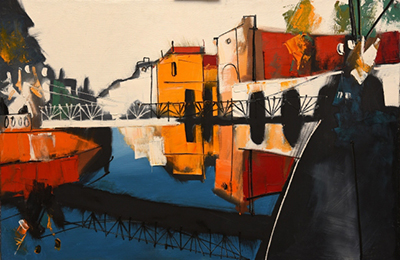
Sergei Nikitin works with the urban landscape—and this is a fundamentally different way of looking at reality than the other three artists. If Nelyubovich turns St. Petersburg into a sign and Pak seeks the human being within a parable, Nikitin looks at the city as a living, breathing organism in which architecture, light, and the rhythm of everyday life intertwine into a single whole.
His urbanism is not postcard views or tourist documentation of landmarks. It is the gaze of a city dweller who knows the city from the inside: courtyards, streets, bridges, facades, the geometry of windows, and the rhythm of perspectives. In his works, the city appears as the human habitat—with its own atmosphere, mood, and character.
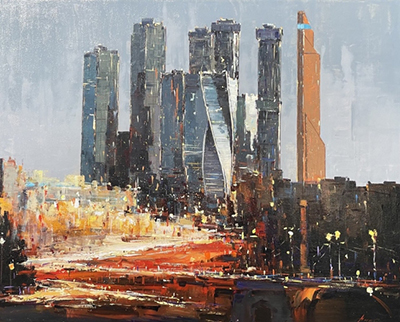
For a collector, Nikitin's urbanism is interesting for several qualities. First, it is a recognizable genre with a broad audience: cityscapes are in demand in private collections, interiors, and corporate collections. Second, it is plastic discipline: behind the external narrative lies work with composition, color, and light. Third, it is emotional accessibility: Nikitin's works do not require specialized knowledge, yet they do not simplify the viewer.
Within the quartet, Nikitin plays an important role: he connects the figuration of Pak and Alekseenko with the generalization of Nelyubovich. His city is neither abstraction nor illustration but an image of an environment in which a person lives. That is precisely why his works fit so organically into a collection where different approaches to reality coexist.
At first glance, there is little in common: symbolic realism, St. Petersburg abstraction, the aviation genre, urbanism. But a curatorial eye sees something else.
All four work with reality but do not copy it. Pak turns the human being into a parable, Nelyubovich turns the city into a sign, Alekseenko turns the airplane into a drama of light, and Nikitin turns streets into an image of an environment. Each of them travels the path from observation to generalization.
All four possess strong plastic discipline. Behind external simplicity or decorativeness lies compositional work. These are not random gestures but a well-calibrated system.
All four have already found their language—and do not change it to suit trends. This is a sign of maturity that collectors especially value when building a collection for the long term.
In the context of Baranow Art Gallery, these four names add up to a three-dimensional statement: contemporary Russian art is not reducible to a single direction. It is diverse—and that is precisely its strength.
Get access to special offers, exclusive promotions, and unique promo codes available only to our subscribers. Along with that, stay updated on the latest global art news and receive fresh insights and announcements from Baranow Art Gallery.

 English
 Русский
 Deutsch