
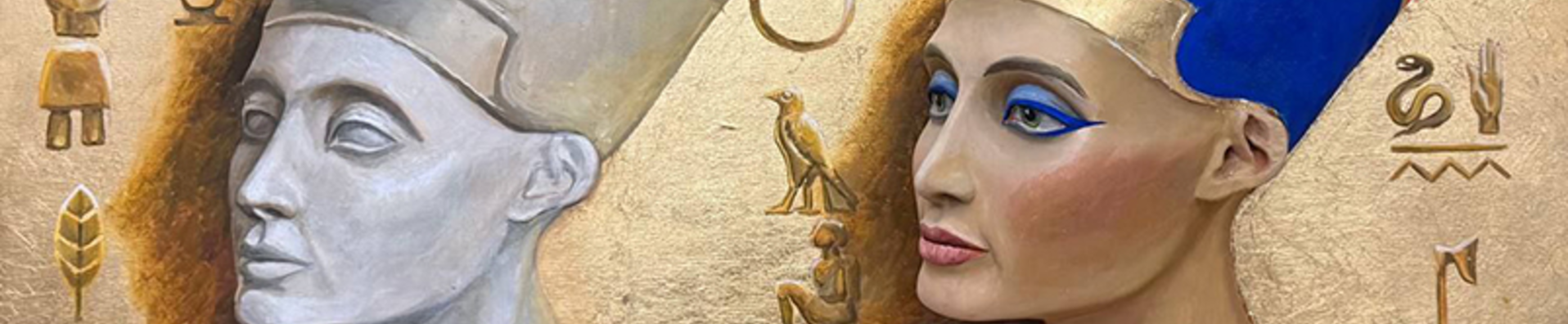
Igor Ryazantsev (René Reza) is the only artist in the world working in the patented Filunism style. Find out how a syringe, acrylic paint, and string theory turned into a work of art exhibited at the Louvre.
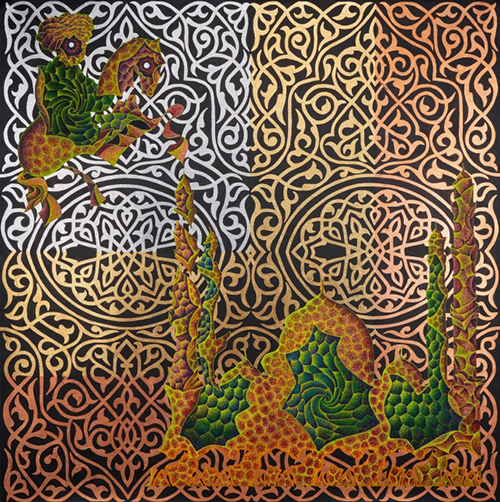
Imagine an artist. In front of them are a canvas, a palette, and brushes. Everything is as usual. And now, forget about all of this. Because Igor Ryazantsev, known to the world as René Reza, works differently. Instead of a brush, he holds a 10‑cubic‑centimeter medical syringe filled with acrylic paint. Instead of brushstrokes, there are thin coloured threads that are laid onto a primed black canvas.
This is not about shock value or an attempt to attract attention at any cost. This is filunism. The style that Ryazantsev invented, developed, and patented on December 20, 2011. The style in which he remains the only artist in the world today.
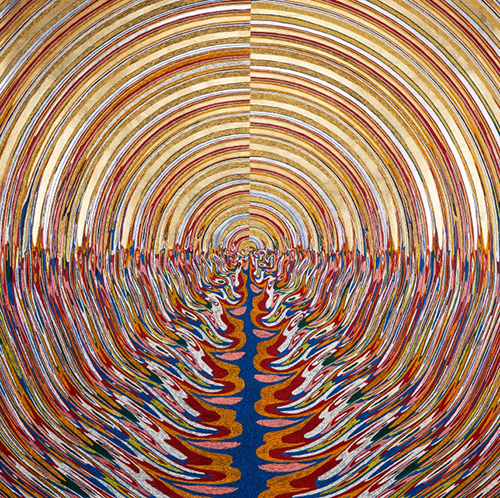
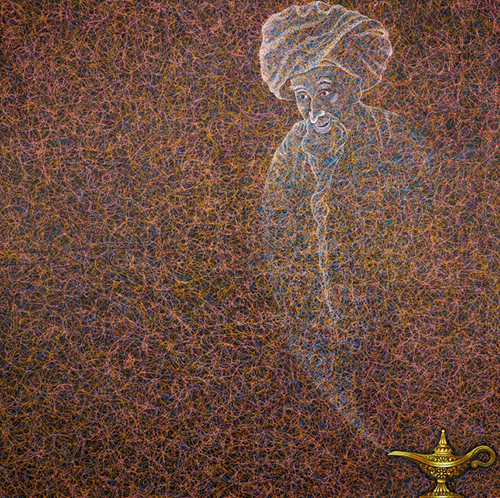
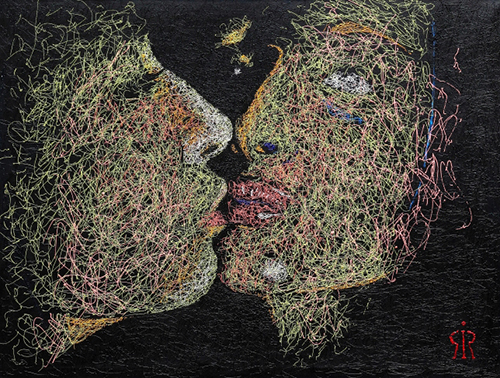
The name comes from the Latin “filum” — “thread,” “fiber.” And it’s not just a beautiful word. In filunism, the thread is not a metaphor, but a real working tool. The artist squeezes acrylic paint through the needle of a syringe — he deliberately shortens the needle to achieve the desired thickness and pressure — and applies it to the canvas in thin lines. There can be several dozen such layers, sometimes more than fifty in a single work. For a painting measuring two by two meters, about a thousand syringes are required.
The result is not painting in the usual sense of the word, but an acrylic tapestry. From a distance, it looks like a three‑dimensional, almost sculptural image. Up close, it’s clear that each line is a separate “stroke” left by the needle of a syringe. René Raza’s paintings can be touched with your hands — this is not prohibited at exhibitions, and visitors often can’t believe that what they’re looking at isn’t weaving or relief, but painting.
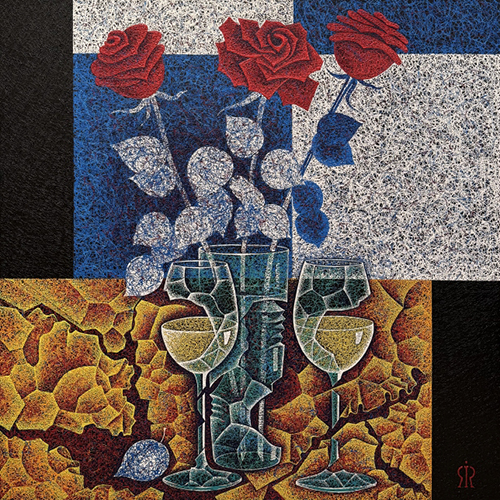
But filouism is not just a technique. It’s a worldview. The artist himself says that his method is a kind of “string theory” in art. In quantum physics, string theory attempts to describe all fundamental interactions through the oscillations of microscopic strings. René Réza transfers this logic to the canvas: everything in the world is connected by invisible threads — people, events, eras, the past and the future. Even the severed threads, in his view, continue somewhere in infinity, in parallel worlds, in dimensions inaccessible to our perception.
Hence the main task of filunism, formulated in the manifesto: to find the threads that connect the Creator, the artist, and the viewer. Painting becomes not just an image, but an attempt to grasp these connections. The artist does not paint an “object,” but a relationship. It is no coincidence that the Latin word “filum” (thread) and the English word “feeling” share a common root — the thread leads to feelings, to consciousness and the subconscious.
Ryazantsev’s story is the story of a long search. At the age of nine, his parents sent him to an art school — he recalls that the choice was between ballet and “art school,” and he chose the lesser of two evils. But it was there that the director told him a phrase that became his life motto: “There are millions of draftsmen, but few artists. If you want to become one of them, create something new.”
The idea to draw with a syringe came only at the age of 46. Before that, there were years of experiments, failures, and ruined materials. The first experiments were with plexiglass and threads. Then came attempts to squeeze paint out of a syringe. The paint wouldn’t yield. It took three years to figure out: you need to break the needle. Then the pressure changes, and the paint lays down as it should.
In 2011, Ryazantsev obtained a patent for filunism. For him, it’s a matter of principle: Picasso didn’t patent Cubism, but he patented his own style. This is not vanity, but a way to show that philunism is not a technique “in the spirit” of something, but an independent style with an author, a date of birth, and a philosophical foundation.
.jpg)
Today, philunism is represented on the international stage. In 2017, René Reza represented Russia at the annual Carrousel du Louvre contemporary art exhibition in Paris — one of the most prestigious venues. His works were exhibited in Kazakhstan, Belarus, France, and at the Erarta Museum of Contemporary Art in St. Petersburg.
Among his landmark works is a portrait of Grigory Rasputin (2013). This work caused a great stir. So much so that at an exhibition at the Louvre, Rasputin’s great‑granddaughter, Lawrence Io Solovyova, approached the artist. Ryazantsev gave her the portrait. She burst into tears.
Another large‑scale project is “The Great Silk Road,” which began in 2016. It’s an “artistic Wikipedia” — a kilometer‑long painting consisting of individual panels measuring two by two metres, each dedicated to a separate civilization, culture, or historical event. The project is ongoing and may include works created together with the audience during performances.
Filunism is not just exotic. This is an attempt by a 21st‑century artist to pose an old philosophical question in a new way: what comes first — the material or the spiritual? René Reza answers through the technique itself: the paint is material, the thread is tangible, but what it connects is invisible. The painting becomes visible through a series of invisible connections.
A nominee for the Guinness World Records in the “Unique” category, the founder of the “Philun Development Center” foundation.
Get access to special offers, exclusive promotions, and unique promo codes available only to our subscribers. Along with that, stay updated on the latest global art news and receive fresh insights and announcements from Baranow Art Gallery.

 English
  Русский
  Deutsch