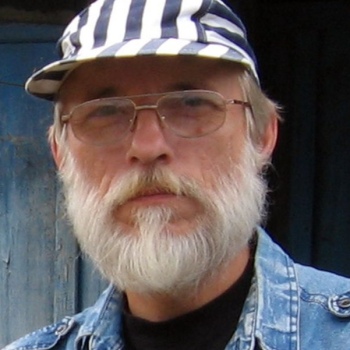
Member of the Professional Union of Artists of Russia, rating 4B – an established professional artist, in demand in the art market.
It is pointless to approach an artist with questions like: what did you want to say with your painting, what is depicted on it? Researchers, critics, and ordinary viewers should first ask these questions of themselves. I was convinced of this when I got acquainted with the artist Vladimir Abaimov.
It so happened that even before seeing the artist’s paintings, I was able to learn the opinions of viewers about them from the guest books at his exhibitions. Reading this fascinating document, it was impossible to determine how to regard the artist: some envied his talent and admitted that he was close and understandable to them, others advised him to change his occupation and understood nothing in his paintings. Moreover, some confidently predicted the artist’s prosperity and success like astrologers, while others with no less certainty foretold the fading of his creativity.
A work of art appeals directly to our soul and feelings, and by dissecting a painting like a butterfly, we simply deprive it of its original meaning. And viewers continue to ask: why, what is this, or assert: it’s not like that, it can’t be. But doesn’t each of us know the difference between an object and the thought it evokes, between the visible, concrete, and associations, fantasies, elusive and mysterious transformations of feelings in our soul? The artist who can express and show this is like a medium translating sounds, words, feelings into colors and lines. The variety of themes and techniques of Vladimir Abaimov seems to some like the artist playing with the viewer, to others – his inability to find himself, “his theme”.
The artist himself explains that the choice of style, form, and technique is dictated by a specific goal, the content of the concept. If he is attracted by the matte firmness of Siberian apples, then he takes these apples as they are, and the viewer looks at the “Still Life with Wine” almost with appetite and enjoys their freshness.
These paintings are realistic, understandable, and liked by viewers. However, others leave them puzzled: “what can torn parts say about torn parts?” “Pink Floyd” is clear, but why above the city? – they ask about the painting “You Should Be There (“Pink Floyd” Above the City)”. Knowing the music of this band, it seems to me that it has a rare quality nowadays, inherent perhaps only to classical music – the ability to soar, to be “above,” to be otherworldly, to drift into the sky.
The artist said that at one time such paintings simply did not pass exhibitions: “understandable” paintings were set aside on one side, “incomprehensible” on the other.
A person walking away in the twilight from the crucified Christ. Back turned to Christ, head bowed in thought (the painting “Solitude”). What is this – a search for God or an answer within oneself? Everything is possible. And there are many answers and thoughts for a thoughtful, moved viewer.
“Have you noticed,” Vladimir asks me, “how the viewer changes from exhibition to exhibition?” I somehow remembered one record of such a viewer, sounding almost poetic: “What business is it of ours – whether you suffered or not? Why should we know your turmoil?” Interesting, where did he see an artist who is not troubled and not suffering? Any true artist, by virtue of his uniqueness, is doomed to loneliness and, even if partial, misunderstanding. And the tragedy or happiness of the artist lies in his inability to close off or turn away from the outside world. The presence of inner freedom, as an indispensable condition of creativity, gives the artist the right to work without looking back, but then the painting is finished, and the moment inevitably comes when it must be shown, brought outside.
On the way to the viewer, Vladimir Abaimov went through many doubts, objective and subjective difficulties. He organizes his exhibitions himself, hanging the paintings in the order he conceived. This order, by the way, does not facilitate easy perception, but the artist consciously mixes genres and styles: after all, in life nothing is neatly arranged on shelves. I regret not having seen all of Abaimov’s paintings – some have been bought and taken abroad by foreigners, some are in private collections and galleries in the city and Russia.
About ten works were “appreciated” by grateful viewers in their own way – they simply stole them from exhibitions. But the game is worth the candle at least because such reviews exist: “I want to return to your paintings, to look and think,” “You see the world differently than I do, but I like your view.”
In my soul, a whole choir of voices did not quiet for a long time: the artist’s, the viewers’, my own, and before my eyes one image after another created by Vladimir passed by: sometimes it was the laughing happy face of the artist’s wife, sometimes Louis Armstrong blowing his soul through the trumpet… I saw how the artist, in whose soul a clear image has already matured or is just beginning to emerge, approaches a clean white canvas or sheet of paper before the creation of the world and cannot touch it because he is afraid of the responsibility as a creator. But he will still do his work, otherwise why did he come into this world?
Olga Babanova
Member of the Professional Union of Artists of Russia, rating 4B – an established professional artist, in demand in the art market.
It is pointless to approach an artist with questions like: what did you want to say with your painting, what is depicted on it? Researchers, critics, and ordinary viewers should first ask these questions of themselves. I was convinced of this when I got acquainted with the artist Vladimir Abaimov.
It so happened that even before seeing the artist’s paintings, I was able to learn the opinions of viewers about them from the guest books at his exhibitions. Reading this fascinating document, it was impossible to determine how to regard the artist: some envied his talent and admitted that he was close and understandable to them, others advised him to change his occupation and understood nothing in his paintings. Moreover, some confidently predicted the artist’s prosperity and success like astrologers, while others with no less certainty foretold the fading of his creativity.
A work of art appeals directly to our soul and feelings, and by dissecting a painting like a butterfly, we simply deprive it of its original meaning. And viewers continue to ask: why, what is this, or assert: it’s not like that, it can’t be. But doesn’t each of us know the difference between an object and the thought it evokes, between the visible, concrete, and associations, fantasies, elusive and mysterious transformations of feelings in our soul? The artist who can express and show this is like a medium translating sounds, words, feelings into colors and lines. The variety of themes and techniques of Vladimir Abaimov seems to some like the artist playing with the viewer, to others – his inability to find himself, “his theme”.
The artist himself explains that the choice of style, form, and technique is dictated by a specific goal, the content of the concept. If he is attracted by the matte firmness of Siberian apples, then he takes these apples as they are, and the viewer looks at the “Still Life with Wine” almost with appetite and enjoys their freshness.
These paintings are realistic, understandable, and liked by viewers. However, others leave them puzzled: “what can torn parts say about torn parts?” “Pink Floyd” is clear, but why above the city? – they ask about the painting “You Should Be There (“Pink Floyd” Above the City)”. Knowing the music of this band, it seems to me that it has a rare quality nowadays, inherent perhaps only to classical music – the ability to soar, to be “above,” to be otherworldly, to drift into the sky.
The artist said that at one time such paintings simply did not pass exhibitions: “understandable” paintings were set aside on one side, “incomprehensible” on the other.
A person walking away in the twilight from the crucified Christ. Back turned to Christ, head bowed in thought (the painting “Solitude”). What is this – a search for God or an answer within oneself? Everything is possible. And there are many answers and thoughts for a thoughtful, moved viewer.
“Have you noticed,” Vladimir asks me, “how the viewer changes from exhibition to exhibition?” I somehow remembered one record of such a viewer, sounding almost poetic: “What business is it of ours – whether you suffered or not? Why should we know your turmoil?” Interesting, where did he see an artist who is not troubled and not suffering? Any true artist, by virtue of his uniqueness, is doomed to loneliness and, even if partial, misunderstanding. And the tragedy or happiness of the artist lies in his inability to close off or turn away from the outside world. The presence of inner freedom, as an indispensable condition of creativity, gives the artist the right to work without looking back, but then the painting is finished, and the moment inevitably comes when it must be shown, brought outside.
On the way to the viewer, Vladimir Abaimov went through many doubts, objective and subjective difficulties. He organizes his exhibitions himself, hanging the paintings in the order he conceived. This order, by the way, does not facilitate easy perception, but the artist consciously mixes genres and styles: after all, in life nothing is neatly arranged on shelves. I regret not having seen all of Abaimov’s paintings – some have been bought and taken abroad by foreigners, some are in private collections and galleries in the city and Russia.
About ten works were “appreciated” by grateful viewers in their own way – they simply stole them from exhibitions. But the game is worth the candle at least because such reviews exist: “I want to return to your paintings, to look and think,” “You see the world differently than I do, but I like your view.”
In my soul, a whole choir of voices did not quiet for a long time: the artist’s, the viewers’, my own, and before my eyes one image after another created by Vladimir passed by: sometimes it was the laughing happy face of the artist’s wife, sometimes Louis Armstrong blowing his soul through the trumpet… I saw how the artist, in whose soul a clear image has already matured or is just beginning to emerge, approaches a clean white canvas or sheet of paper before the creation of the world and cannot touch it because he is afraid of the responsibility as a creator. But he will still do his work, otherwise why did he come into this world?
Olga Babanova


 English
  Русский
  Deutsch