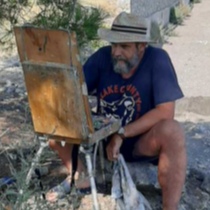
On the picturesque canvases of Ilya Alexandrovich Bogatov, there is a clear representation of a life and creative philosophy based on traditional values. The meticulousness and craftsmanship of the painting refer the viewer to the great predecessors of the artist. Even before receiving his professional diploma, Bogatov’s studies attracted attention with their careful painterly finish, skill, unpretentious motifs, freshness of vision, and liveliness characteristic of the Russian mood landscape. The harmony of nature and man, themes of silence and tranquility, the "calm wind" are read in the programmatic works and studies in landscape, portrait, and historical genres.
Ilya Bogatov’s childhood fell on the late Soviet period. With his parents, he traveled across the vast country and gained vivid, invaluable, and diverse impressions. In his youth, during the perestroika era, enriching his life experience, he tried many professions of different qualifications. In his mature years, he consciously and responsibly chose the profession of an artist and his place of residence—the village of Lezhnevo. These last two circumstances: professional responsibility and life in an old trading and industrial village in the center of Russia—shaped the artist’s sense of time and space, ideology, and style.
Like many creative people, the Russian hinterland became for him a place to comprehend the moral essence of folk life and a source of inspiration. Lezhnevo, founded in times immemorial at a busy crossroads of trade routes, is first mentioned in written sources of the 16th century as a wealthy state village. The preserved religious, industrial, and residential buildings in the style of provincial classicism, organically integrated into the natural environment, make Lezhnevo one of the most interesting places in the Ivanovo region.
In the landscape genre, the artist’s focus includes not only natural views and architectural structures but also animalistic subjects rare for city dwellers. The wet early spring, the rain-swollen autumn sky, the diffused light of a summer evening, stone and wooden houses, bridges, horses, cows, chickens captivate the viewer not with external effects but with the possibility of deep sincere empathy. The wisdom of old age, the merits of middle life, enlightenment through Orthodox faith, the immediacy of childhood, the introspection of adolescence—these are themes of Bogatov the portraitist. The artist’s turn to the historical genre is no coincidence; it is motivated not so much by an interest in the dynamics of historical events as by ethnography and the everyday life of the 13th and subsequent centuries. Often the artist’s model, not only in portraits but also in historical paintings, is his wife Olga, while male characters reveal self-portrait features: the past is tied in a tight knot with the present.
Having achieved freedom in his craft, perfecting a realistic manner, and finding his own themes in various genres, Ilya Bogatov, avoiding momentary flashy and superficial techniques, continues to develop in the traditional humanistic direction of Russian art. This is what makes him appealing.
On the picturesque canvases of Ilya Alexandrovich Bogatov, there is a clear representation of a life and creative philosophy based on traditional values. The meticulousness and craftsmanship of the painting refer the viewer to the great predecessors of the artist. Even before receiving his professional diploma, Bogatov’s studies attracted attention with their careful painterly finish, skill, unpretentious motifs, freshness of vision, and liveliness characteristic of the Russian mood landscape. The harmony of nature and man, themes of silence and tranquility, the "calm wind" are read in the programmatic works and studies in landscape, portrait, and historical genres.
Ilya Bogatov’s childhood fell on the late Soviet period. With his parents, he traveled across the vast country and gained vivid, invaluable, and diverse impressions. In his youth, during the perestroika era, enriching his life experience, he tried many professions of different qualifications. In his mature years, he consciously and responsibly chose the profession of an artist and his place of residence—the village of Lezhnevo. These last two circumstances: professional responsibility and life in an old trading and industrial village in the center of Russia—shaped the artist’s sense of time and space, ideology, and style.
Like many creative people, the Russian hinterland became for him a place to comprehend the moral essence of folk life and a source of inspiration. Lezhnevo, founded in times immemorial at a busy crossroads of trade routes, is first mentioned in written sources of the 16th century as a wealthy state village. The preserved religious, industrial, and residential buildings in the style of provincial classicism, organically integrated into the natural environment, make Lezhnevo one of the most interesting places in the Ivanovo region.
In the landscape genre, the artist’s focus includes not only natural views and architectural structures but also animalistic subjects rare for city dwellers. The wet early spring, the rain-swollen autumn sky, the diffused light of a summer evening, stone and wooden houses, bridges, horses, cows, chickens captivate the viewer not with external effects but with the possibility of deep sincere empathy. The wisdom of old age, the merits of middle life, enlightenment through Orthodox faith, the immediacy of childhood, the introspection of adolescence—these are themes of Bogatov the portraitist. The artist’s turn to the historical genre is no coincidence; it is motivated not so much by an interest in the dynamics of historical events as by ethnography and the everyday life of the 13th and subsequent centuries. Often the artist’s model, not only in portraits but also in historical paintings, is his wife Olga, while male characters reveal self-portrait features: the past is tied in a tight knot with the present.
Having achieved freedom in his craft, perfecting a realistic manner, and finding his own themes in various genres, Ilya Bogatov, avoiding momentary flashy and superficial techniques, continues to develop in the traditional humanistic direction of Russian art. This is what makes him appealing.


 English
  Русский
  Deutsch